Three Notebooks
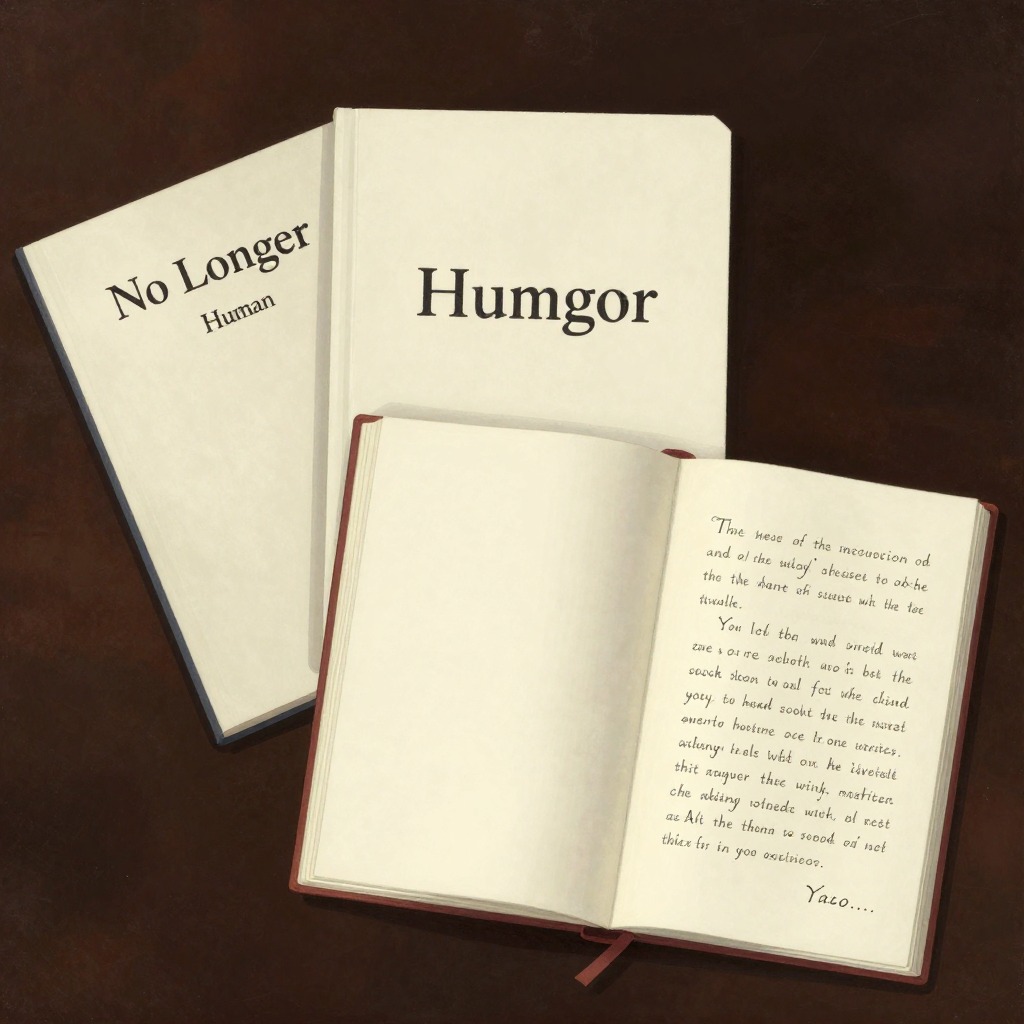
The Three Notebooks are the autobiographical manuscripts written by Yozo that constitute the entirety of the first-person narrative in No Longer Human. They are not merely a plot device but the very substance of the novel, a confessional record through which Yozo recounts his life from childhood to his confinement in a mental hospital. The notebooks are delivered to the Madam of the Kyobashi bar after Yozo's disappearance and are later passed to the unnamed narrator of the epilogue, who decides to publish them verbatim, making them the structural and thematic core of the work.
Origin and Discovery
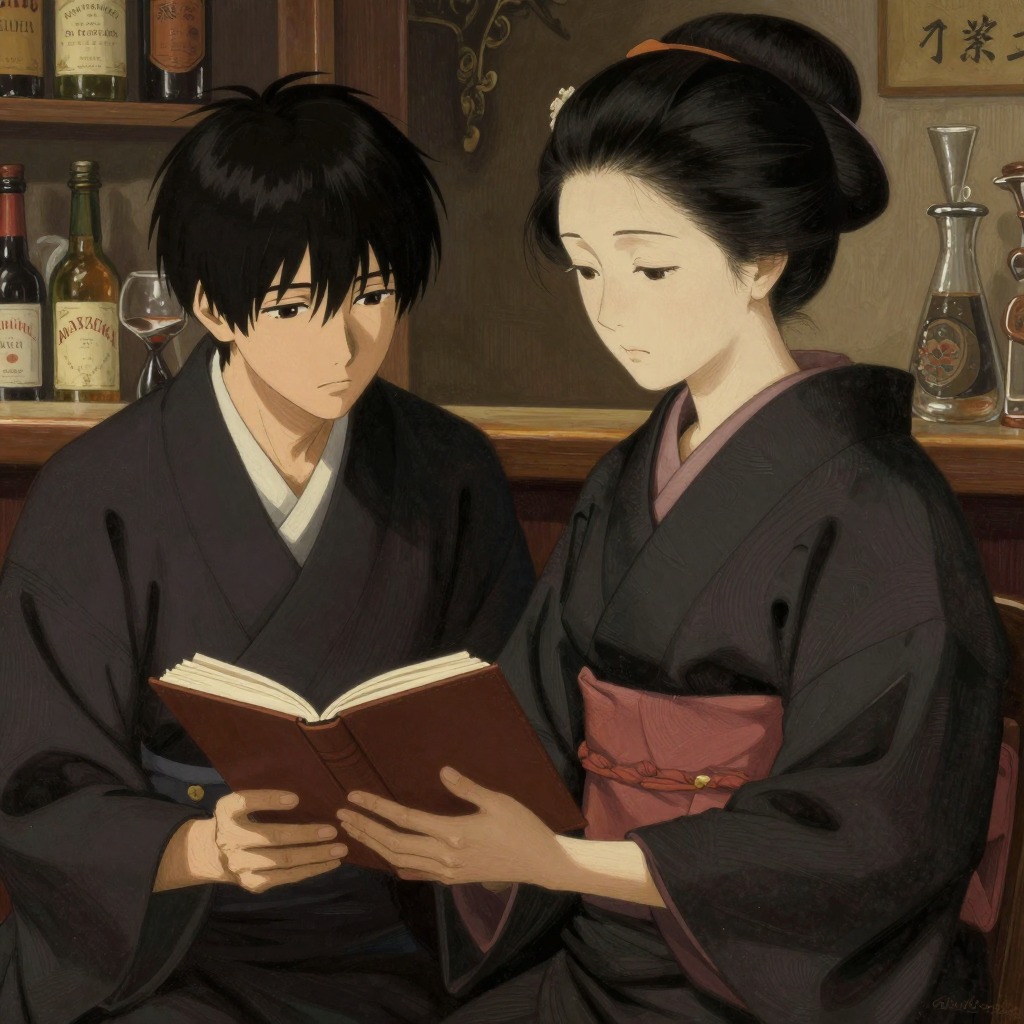
The notebooks come into existence as Yozo's desperate attempt to document his own experience. They are sent, without a return address or name, to the Madam of the Kyobashi bar about ten years before the epilogue's present. The Madam keeps them through the chaos of the war, and they survive the air raids that destroy much of her property. When the unnamed narrator visits her coffee shop in Funabashi in February of an unspecified year, she retrieves the notebooks and three accompanying photographs from inside the shop, offering them to him as potential material for a novel. The narrator, initially reluctant, is fascinated by the photographs and accepts the manuscripts, spending the entire night reading them at his friend's house.
Content and Structure
The notebooks are divided into three sections, each corresponding to a distinct phase of Yozo's life. The First Notebook covers his childhood in a wealthy family in northeastern Japan, his early dread of human beings, and his invention of clowning as a survival mechanism. The Second Notebook details his adolescence and young adulthood, including his friendship with Takeichi, his discovery of van Gogh's paintings (which he and Takeichi call "ghost pictures"), his move to Tokyo, his involvement with Masao Horiki, his participation in a leftist Reading Society, and his love suicide attempt with Tsuneko. The Third Notebook is split into two parts: Part One describes his life as a kept man with Shizuko and his marriage to Yoshiko; Part Two recounts Yoshiko's violation, Yozo's descent into alcoholism and morphine addiction, his confinement in a mental hospital, his father's death, and his final years as a "reject" living in a dilapidated house by the sea, cared for by an old servant named Tetsu. The notebooks end with Yozo's reflection that he has "neither happiness nor unhappiness" and that "everything passes."
Thematic Significance
The notebooks are the vehicle for Yozo's central philosophical and emotional struggles. They contain his meditations on the fear of human beings, the nature of society (which he comes to understand as a collection of individuals engaged in "then-and-there" contests), the meaning of crime and punishment, and the question of whether trustfulness is a sin. They also record his artistic aspirations, particularly his lost "ghost pictures"—self-portraits painted in a style inspired by van Gogh and Modigliani, which he considers his only true masterpieces. The notebooks are filled with recurring motifs: the lion mask incident, the undrunk glass of absinthe, the dream of going on bicycles to see a waterfall, and the toad as a symbol of his degraded state. They are, in Yozo's own words, a "life of shame."
Narrative Role and Evaluation
The notebooks function as an embedded first-person confession within a third-person frame. The epilogue's narrator, who never met Yozo, presents the notebooks without alteration, claiming that any attempt at improvement would be clumsy. This framing creates a complex narrative structure: the reader encounters Yozo's self-portrait through his own words, but the epilogue provides an external perspective that complicates that portrait. The Madam of the Kyobashi bar, when asked if she cried reading them, replies, "No. I didn't cry . . . I just kept thinking that when human beings get that way, they're no good for anything." Yet the narrator, reflecting on the notebooks, concludes that Yozo was "an angel," a judgment that stands in stark contrast to Yozo's own relentless self-condemnation. The notebooks thus become a site of interpretive tension, inviting the reader to weigh Yozo's account against the testimony of those who knew him.